
From Campus Improvement Plan to Daily Practice

Listen to This Article
As Texas school leaders prepare for a new school year, principals, central office leaders, and superintendents review available state assessment results—including STAAR® Grades 3–8 and End-of-Course assessments, TELPAS, and alternate assessments, as applicable. Teams examine performance patterns across students, student groups, grade levels, and subjects and consider those results alongside other available evidence to identify priorities and inform campus improvement planning. The work is necessary, but even a well-developed plan may leave open how priorities will translate into daily practice, what evidence leaders will monitor, and when they will adjust course. The central leadership question is not only what the results show. It is what leaders and staff will do differently when they return.
Assessment Results Should Shape Early Instructional Decisions
Spring 2026 STAAR results show the extent to which students demonstrated and applied the assessed TEKS in each tested grade, subject, or course. They can help leaders identify performance patterns, areas of strength, and where additional support may be needed. Leaders should then consider those results alongside student work, local assessments, attendance patterns, intervention records, and classroom evidence to better understand what may be contributing to the outcomes. The goal is to identify the few instructional priorities, student supports, and leadership routines that require greater attention. Before the year gains momentum, leaders should be able to name what matters most, what adults will do differently, and what evidence they expect to see.
Campus Plans Need More Than Progress Ratings
Most CIPs contain reasonable priorities: stronger Tier 1 instruction, more effective PLCs, targeted intervention, improved progress monitoring, or increased coaching. The challenge is rarely the absence of a strategy. It is the gap between the strategy named in the plan and the practice leaders expect to see across classrooms, teams, and student-support systems.
The Effective Schools Framework offers a useful reference point. It emphasizes focused priorities, clear ownership, milestones, regular monitoring, and adjustment when implementation or outcomes fall short. It also moves from broad essential actions to more specific key practices and success criteria, helping leaders define what implementation should look like in practice.
That distinction matters because activity is not the same as execution. A completed training does not confirm that instructional practice changed. A PLC agenda does not show that teachers used student work to determine the next instructional response. An intervention roster does not establish that students received the right support with sufficient consistency. A structured plan-to-outcome process can help leaders connect strategy, implementation evidence, and student response without replacing district judgment, the campus plan, or state guidance.
Connected Evidence Creates Better Leadership Choices
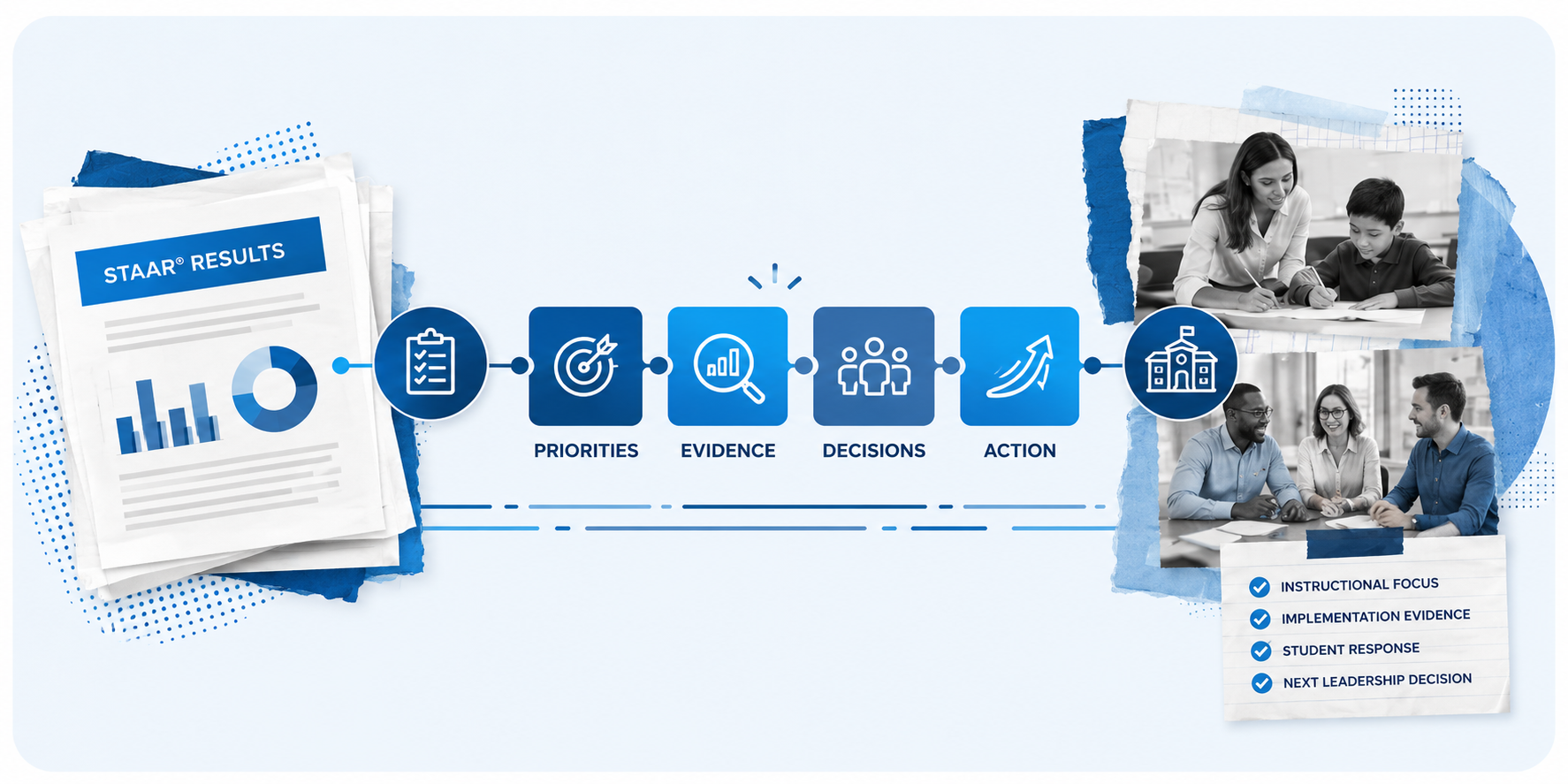
A practical improvement sequence begins with a performance signal and moves through a campus priority, a strategy, an expected change in adult practice, implementation evidence, a near-term student response, and a leadership decision. Each step answers a different question. What pattern deserves attention? What should adults do differently? What should leaders expect to observe? What result would suggest the strategy is gaining traction?
For principals, the first move is to translate broad priorities into observable expectations. If students struggled with written responses, teachers may need stronger modeling, guided practice, feedback, and revision routines. If students had difficulty applying learning in unfamiliar contexts, teams may need to examine task design, questioning, and cognitive demand. “Reteach the standard” is not yet an implementation plan. Leaders must clarify what will change in the learning experience.
The next move is to align monitoring with those expectations. Classroom visits, PLCs, coaching cycles, and intervention reviews should answer focused questions. Are priority practices visible? Are they becoming more consistent? Are teachers using student work to determine the next instructional response? Are coaches concentrating on practices connected to campus priorities? Is intervention adjusted when progress remains limited?
The consequence of weak alignment is not simply a less effective campus plan. Campuses can spend months continuing activities without knowing whether the intended change ever reached classrooms or students. When progress is limited, leaders may be unable to determine whether the strategy is weak, implementation is inconsistent, or the evidence is incomplete. That ambiguity delays action when time matters most.
District leaders can reduce that ambiguity by reviewing implementation evidence alongside student outcomes. Superintendents and principal supervisors should ask what adult-practice change a strategy required, how consistently it is occurring, what near-term student response should be visible, and what barrier requires district action. The ESF theory of action similarly emphasizes assessing current practice, prioritizing gaps, building capacity, and supporting implementation over time.
As the 2026–27 academic year begins, leadership teams should select a small number of priority strategies and define four things for each:
- The expected adult practice
- The evidence that will confirm implementation
- The near-term student response to monitor
- The decision rule for what happens next
Leaders can then continue, modify, intensify, replace, or discontinue a strategy based on connected evidence rather than habit or completion status.
Move Your Campus Plan Into Practice
Blocker Education helps Texas district and campus leaders move improvement priorities into practice with practical tools, analysis, and guidance.
STAAR® is a registered trademark of the Texas Education Agency. The Effective Schools Framework (ESF) is a Texas Education Agency framework. Blocker Education is not affiliated with or endorsed by the Texas Education Agency.